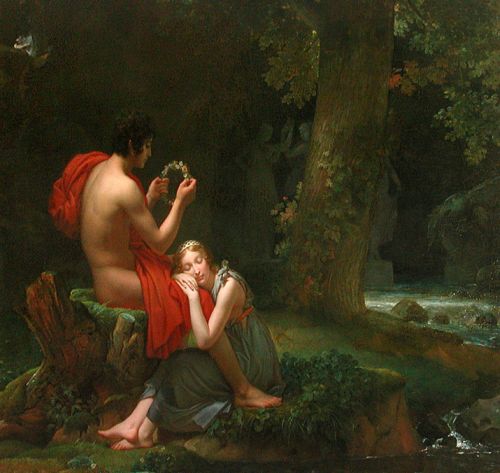
Showing posts with label Ravel. Show all posts

Wednesday, December 8, 2010

Histoires Naturelles

Maurice Ravel (1875-1937), in composing his song cycle Histoires Naturelles, did not intend to completely rewrite the story of Jules Renard’s famous poems that he was setting. In fact, in explaining his desire to set Renard’s poetry to Renard himself, Ravel responded “Mon dessein n'était pas d'y ajouter, mais d'interpreter... Dire avec de la musique ce que vous dites avec des mots” (“My intention was not to add, but to interpret… To say with music that which you say with words”). This intention is readily apparent in the five song cycle, which tells the stories of five animals; the peacock, the cricket, the swan, the king fisher, and the guinea hen. Using what was at the time a radical form of word setting, Ravel imitates the pace, vocal patterns, and attitudes of the five animals. The first song Le Paon’s tempo marking reads “Sans hâte et noblement” (“Without haste and nobly”), and later “Avec majesté” (“with majesty”), and the second song Le Grillon’s tempo marking simply reads “Placide” (placid). Because of this careful interpretation of the poetry, the songs have an extremely expressive and dramatic quality; the peacock cries out in anguish over its mate’s absence, and the kingfisher waits quietly for its meal, both in the lyrics and the music.

Though Ravel had achieved a certain amount of critical and professional success when he composed Histoires Naturelles at 32, and had already composed pieces such as Jeux d’eau and his cantatas Myrrha, Alycone, and Alyssa which are still popular today, he had certainly not received critical or popular success yet. The cycle was premiered in 1907 by Jane Bathori, with Ravel himself accompanying, to a dissatisfied, even rowdy audience. The concertgoers were upset with the radical text-setting that Ravel had used, and according to the report one attendee, found some irony in the first lyrics of Le Martin Pecheur: “Ça n'a pas mordu, ce soir…" (“It hasn’t bitten, this evening”), and openly guffawed during the pauses of Le Grillon. Bathori later explained how radical the cycle really was, saying that it had “completely broken with what is customarily called ‘melody.’ The voice was subservient to the prosody, which embraced the text to such an extent that the mute e’s were no longer heard”. What Bathori means by the last section of that quotation is that the text the performer sings more closely approximates how French is spoken than how it was traditionally sung, as was done to a certain extent by composers such as Mussorgsky and Chabrier, but never before to this extent. This break with tradition may seem small to the modern audience member, who has heard considerably more radical breaks with the melodic tradition, but to Ravel’s contemporaries, this music was unlike anything they had heard before, and at first upset them. Much like The Rite of Spring by Stravinsky and Pelléas et Melisande by Debussy, however, the initial popular hostility to Histoires Naturelles has since yielded, and the pieces have become staples in the French song repertory.

Tuesday, December 7, 2010

Analysis of Ravel's Menuet sur le Nom d'Haydn

Maurice Ravel’s Menuet sur le Nom d’Haydn, composed in 1909 as part of a series of compositions commissioned by a French magazine from composers including Debussy and d’Indy, is at first glance quite a simple piece. The piece, like the others commissioned with it, is written based on the theme “B-A-D-D-G”, a musical transcription of Haydn’s name using the German tradition of “H” being what we would call “B natural”, “D” and “A” being their respective pitch names, and Y and N corresponding to where they would fall if the scale were repeated through the alphabet (“D” and “G” respectively). This progression of notes appears repeatedly through the song, a total of 8 times, sometimes in the melody, others in the background. In measure 19, in the left hand, Ravel even uses the same theme backwards (G-D-D-A-B); in measure 25 he intentionally uses the notes achieved by rotating the staff of the original melody 180 degrees (D-G-G-C#-B).

The piece, at fifty four measures long, is in rounded binary form (AABA, the form traditionally used in minuets), a form which Haydn used extensively in his symphonies, sonatas, and other instrumental works. The “A” theme itself, and much of the “B” theme, is analyzable in terms of tonal harmony, though even in these parts Ravel stretches the rules to fit 20th century influences, including Jazz. For instance, the first two chords, “ii7” and “iii7” in the key of G major, would almost never be seen next to each other in tonal harmony. Most of the chords in the first theme have at least a seventh added on to them, sometimes even an altered seventh as in the “V” major-major seventh chords in bars five and six, moving towards the half cadence in measure eight. On the first beat of measure seven, Ravel even employs a vi11 chord, which would essentially never be seen in classical period music.

The “B” section, however, moves into much more complex areas than the “A” section. It rapidly modulates through a series of keys, and though up to measure 38, it maintains a fairly strong tonal center with-in each two or four bar phrase, the seventh and ninth chords obscure much of the connection to traditional harmonic patterns. Beginning in measure 38, however, Ravel combines a simple upward chromatic scale with a series of descending chordal patterns in the right hand and ascending chordal patterns in the left hand, creating an incredibly complex and dissonant harmony, all over a B pedal, which builds tension and volume into the return of the A theme at the end of bar 43.

The final iteration of the “A” theme is similar to the first and second iterations, although the second half of the theme goes briefly into C major (IV of G major), leading into the last six bars, a coda which modulates through the keys a minor and A flat major (ii and the Neapolitan of G major respectively), into the final cadence in G major. Though these key changes are direct and fairly chromatic, the idea of altering the second theme going into the coda is absolutely a device that was used during Haydn’s lifetime. Menuet sur le Nom d’Haydn is a piece that is at once modern and classical; the ornamentations, phrase structure, and most of the tonal movement serves the same purpose as the music of a Haydn minuet would (though Ravel’s minuet is far less “danceable”) tonally, but the chromaticism and “jazz chords” give it a deeply modern edge.

Sunday, November 14, 2010

Practice makes tired

Due to an extremely surprisingly small amount of homework, I spent a lot of time in the practice room this weekend. I mostly worked on one piece by Ravel that I am working on for piano right now. I spent far more time practicing in the last few days than I had in any similar period of time before. It was a huge help in learning the piece, but sucked a lot of energy out of me. I found that when people came in to talk to me while I was practicing, I was unable to concentrate on what they were saying, and could hardly keep a conversation going. While I was practicing, I could concentrate extremely well on the piece, but then as soon as I had to think about something else, it was as though a wall had been built up around my brain to protect it from extraneous thoughts...
Just some observations.


Tuesday, November 9, 2010

Relaxation Music/ Wavelength

Today, I was really stressed out coming home from school, just because of classes, etc. I tried laying down for a while to take a nap, which didn't really help. After that, I got up and made some dinner, and turned on my prized CD of Vlado Perlemuter playing Ravel's piano music. Something about this music speaks to me on a level that very few other composers can. I love the music of composers like Mozart and Beethoven, but I cannot connect in the same way. Even Ravel's contemporary Debussy doesn't have the same soothing, connective impact on me. Another composer that often does have this impact is Henry Purcell. However, as much as I love someone like Handel, he just doesn't speak to me the same way. This is a strange system that I cannot explain at all, and perhaps it is only temporary, but it is quite interesting.

What I've been listening to today:
La Valse by Ravel
Vlado Perlemuter plays Ravel

Friday, October 29, 2010

Don't be distracted (No, I don't want to feel pain)

I just got back from a concert at the Schnitzer Concert Hall in downtown Portland. It was absolutely incredible; I'll probably put up a full review soon.
I feel like I've gone through a huge change in the music I listen to and the way I interpret it this semester. I have learned about a lot of Renaissance and Medieval era music, which has opened my eyes to all kinds of different rhythmic and harmonic possibilities that I hadn't ever heard before. I have also begun to explore more deeply some of the genres of music that I had only glossed over in the past. As far as popular music goes, I have greatly expanded my capacity for concentrating on the intricacies of the music I am listening to, which is a wonderful new experience.
So yeah, that's exciting.


What I've been listening to today:
A Concert, by Sufjan Stevens!
Songs of Ravel and Poulenc, performed by Pierre Bernac
Schubert's Winterreise Cycle, performed by Dietrich Fischer Dieskau

Wednesday, October 27, 2010

Reading Music like a Book


I have loved listening to the music from Maurice Ravel's "Symphonie Choreographique" Daphnis and Chloe for a very long time now; its lush harmonies evoke the flourishing emotional lives of the two main characters of the ballet in an overwhelmingly beautiful fashion. The choral part is otherworldly, taking me back to ancient Greek times, imagining the incredibility of the world around me as viewed through the prism of life before immediate communication and near-immediate transportation. However, it wasn't until this evening that I had ever seen the score to Daphnis, an immense book of about 300 pages that details the large orchestral, choral, and dancing forces required to execute the piece fully as Ravel imagined it. I listened to about half of the piece while watching the score, at which point I was so overwhelmed by the piece that I was unable to continue. It is similar to the feeling that you get when you've learned a piece to perform it, so that you know the inner details and devices that the composer used to create the sound that goes out to the audience. Though I do believe that there is another entirely different allure to listening to music without and sheet music to distract you or control your reactions, I think that once you know a piece fairly well, reading the music along is the best way to deepen your enjoyment of the piece.


Saturday, October 23, 2010

Time


I just got back from school, where I practiced for 4 hours. It was fun, and reminded me of how good it feels to put a significant amount of work into something, and to be able to see the difference. It's really a shame that I take lessons during the parts of my life during which I have the least amount of time to practice; if I could practice this much every other day, I think that I would be able to make a great amount of improvement. Perhaps I will make a more concerted effort to practice, or even to take lessons during the summer and winter breaks.

We had our concert at the Hawthorne Theater the other night, which went amazingly! It was wonderful to be able to perform in a venue which had pretty decent sound, and it felt so good that 20 or so of our friends made the trek out there and paid the money to see us perform. I hope that we will get some more opportunities to perform around Portland in the near future. I'll post some videos soon :)

What I've been listening to today:

Songs of Maurice Ravel, performed by Gerard Finley
Preludes by Debussy
Ancestor by Throw me the Statue
The Age of Adz by Sufjan Stevens
Ferris Wheel by the Swingle Singers

Saturday, September 4, 2010

Practicing

Today, my band (it's called Bella Novella) tried out a new way of practicing, utilizing headphones, a drum machine, microphones, etc., to attempt to minimize our impact on our neighbors/housemates. It was a strange experience to sit in a garage with three others, listening to each other's instruments through headphones. I think it was a mixed bag in terms of results; on the one hand, we had to concentrate on timing to a greater extent than normal, and were able to pipe a metronome through to keep the tempo consistent (revealing some things to work on that we might not have noticed otherwise). On the other hand, it is difficult to practice on instruments/amplification different to what we use in concerts (we certainly couldn't play this way every practice, or when learning new music). However, practicing this way does open up the opportunity of practicing more often, as well as at more convenient times of the day. I imagine that us huddled in a circle around a bunch of equipment singing without accompaniment must have looked quite strange to any passers by, though!


Here's a link to our first EP

http://bellanovella.bandcamp.com/album/in-uniform


What I've been listening to today:
Symphonies 1, 4 by Mozart
Le Tombeau de Couperin by Ravel
Symphony No. 5 (Choral) by Philip Glass
Sun Giant EP by Fleet Foxes
Serenade by Leonard Bernstein

Monday, August 30, 2010

Ruminating about Resonance

I've been thinking a lot this evening about resonance. Resonance can have many meanings in terms of music; a note can have a certain resonance or amount of vibration, or a piece can have a resonance with a person, among other meanings. When a piece has resonance with me, I feel like it speaks to me, as though it is accessing some subconscious part of me that has been built up through the years to prefer some styles of music over others, to prefer instruments over others, and to prefer certain performance practices over others.

What I've been thinking about is how this same concept that we experience in terms of our musical preference applies to our relationships with other people. As we grow and learn about ourselves over the years, we have built up a set of notions and ideas that comprise not only our self awareness, but also our comfortability with new thoughts and ideas. In the same way that Stravinsky's Rite of Spring or a Schoenberg string quartet can prove to be an uncomfortable experience in someone who has only been exposed to tonal music, our various exposures personally provide a system of comfort, love, and friendship that provides a basis for our interactions with new people. Thus, for some, a person may provide a deep resonance with what is present and absent in their life, and for others the person may seem completely void of interest.

I think, however, that the concept of resonance goes deeper than this, however, because often the piece of music that is most resonant is not the one that conforms to the rules that one is used to, but rather the one that expands the boundaries of one's imagination in a new direction. This way in which a piece can provide resonance through expanding one's imagination of music, I believe, runs parallel to the way that a person can, by expanding one's experience and imagination of life, provide a deeply resonant presence in another's life.


Anyhow, my name is Ethan, and I am a student in Portland, OR. I plan to use this blog to explore classical and popular music, perception, and whatever I happen to be thinking about as I sit down to write the blog. I hope you find it interesting!


What I've been listening to today:

Frederic Chopin's 4th and 5th Nocturnes
Maurice Ravel's Miroirs
Johann Sebastian Bach's Wohltempierte Klavier Book 2
Sufjan Stevens' All Delighted People EP